How to Make Legacy Systems Compliant Without a Full Replacement
Full replacement is not always the answer. Here is how to close compliance gaps in legacy systems through compensating controls, structured gap analysis, and targeted modernization of only what needs to change.
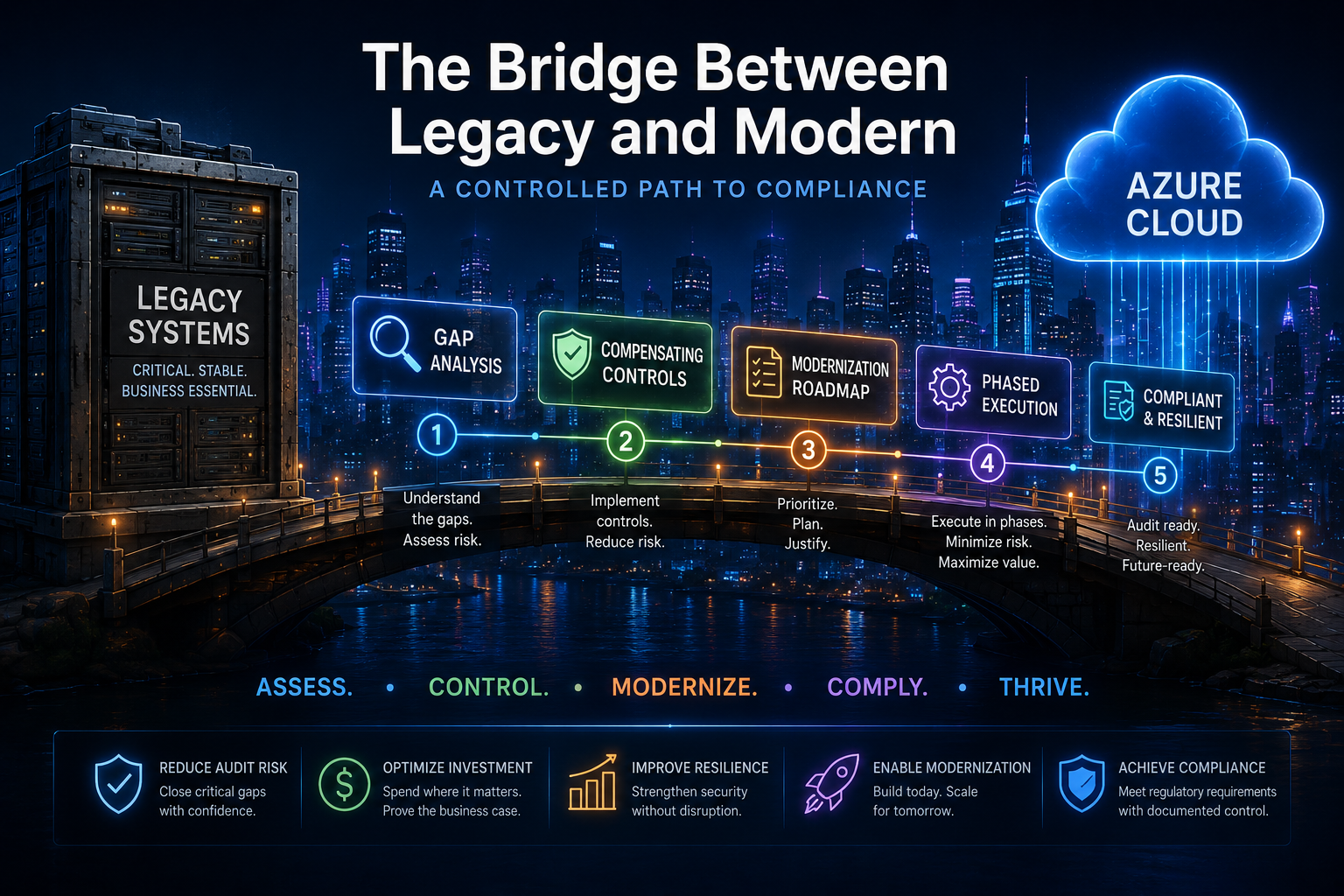
Every enterprise compliance conversation eventually reaches the same uncomfortable moment. The auditor or the regulation or the board risk committee points at a system that has been running since 2008, and someone asks whether it needs to be replaced before the organization can demonstrate compliance. The instinct is to say yes. The honest answer is more complicated.
Full replacement is not always the right move. It is frequently not the fastest move. And for organizations under active compliance pressure with a live audit timeline, it is almost never the first move. What most legacy environments actually need is a structured gap analysis, a set of documented compensating controls, and a phased modernization roadmap that prioritizes risk, not age. That work can bring a legacy system into a defensible compliance posture while a longer-term modernization program runs alongside it on a controlled timeline.
The organizations that handle this well start with the gap analysis. The ones that handle it poorly start with a replacement budget.
Marka's team has worked with enterprises across healthcare, manufacturing, finance, and public administration since 1993, specifically at the intersection of legacy architecture and compliance-driven modernization decisions. If your organization is working through this question now, the right starting point is a conversation before a proposal. You can reach the team directly at marka-development.com/contacts.
Compensating Controls: What They Are and What They Actually Cover
A compensating control is a security or operational measure that satisfies the intent of a compliance requirement when the primary technical control cannot be implemented directly on the system in question. The concept is formally recognized by ENISA, the EU Agency for Cybersecurity, and is built into the implementation guidance for NIS2, DORA, and ISO 27001 alike.
In plain terms: if your legacy ERP cannot natively support multi-factor authentication, a network-layer MFA solution enforced at the access boundary is a compensating control. If your system cannot export structured logs to a SIEM platform, deploying a log aggregator at the network perimeter that captures traffic to and from that system is a compensating control. If your vendor no longer releases security patches, documented network segmentation that isolates the system from lateral movement is a compensating control.
What compensating controls are not is a permanent solution or an automatic pass with auditors. Three things determine whether a compensating control will hold up in an audit.
It must be technically enforced, not just documented. A policy that says "access to the legacy system is restricted to authorized users" is not a compensating control. An access boundary enforced at the network layer that prevents unauthorized connections is. Auditors increasingly ask for evidence of enforcement: configuration screenshots, access logs, test results. Policy documents alone do not satisfy this.
It must address the specific gap it claims to address. Network segmentation reduces lateral movement risk. It does not give you visibility into what is happening inside the system. If the requirement is incident detection, a perimeter control is not a complete compensating control for that gap. You need something that surfaces internal system events, even if that means deploying an agent or a log forwarder against a system that was not designed for it.
It must be proportionate to the risk. Regulators use proportionality language deliberately. A compensating control for a system processing highly sensitive financial data is held to a different standard than one for a lower-risk internal workflow tool. The documentation you build around the control needs to demonstrate that you have assessed the risk correctly and that the control you have chosen is appropriate to it.
When those three conditions are met, compensating controls are a legitimate and widely accepted path to compliance. The mistake is treating them as a shortcut rather than as an engineered solution that requires the same rigor as any other security control.
The Gap Analysis: Where to Start Before Spending Anything
The gap analysis is the only honest starting point. Every other decision, whether to implement compensating controls, which components to modernize first, what the timeline should be, depends on knowing precisely where your current architecture fails against the requirements you are trying to meet.
A well-structured gap analysis for legacy compliance runs through your current system architecture against each specific requirement area and produces three outputs: a list of gaps with their severity and audit risk rating, a list of gaps that can be closed with compensating controls at acceptable ongoing cost, and a list of gaps that require architectural change to close reliably. That third list is your modernization scope.
The requirement areas that most commonly produce gaps in legacy environments are access control and authentication, incident detection and logging, vulnerability and patch management, data encryption at rest and in transit, and supply chain security covering vendor support status. For each area, the gap analysis needs to document not just whether the gap exists but what it would take to close it two ways: through compensating controls and through architectural modernization. That comparison is the foundation of the business case.
The gap analysis is also the entry point for Marka's Cloud and Platform Modernization work. It is not a sales exercise. It is the technical document that tells your organization what it actually needs to do, with enough specificity that your finance team can evaluate the cost of each path honestly. Organizations that skip it and go straight to a modernization proposal are making the most expensive kind of architectural decision: one without complete information.
A Phased Compliance Roadmap for Legacy Environments
Once the gap analysis is complete, the roadmap follows a consistent structure regardless of the specific system or regulation involved. Three phases, in order.
Phase one: stabilize and instrument. Before you can close any compliance gap, you need visibility into what is actually happening in and around your legacy environment. This means deploying monitoring at the network boundary, configuring log aggregation for system events even where native logging is limited, establishing a baseline of normal behavior, and documenting the current access control state. This phase does not require any changes to the legacy system itself. It is entirely perimeter and infrastructure work. It is also the phase that most organizations skip, and the reason they cannot answer an auditor's incident detection questions when enforcement arrives.
Phase two: enforce controls at the perimeter. With visibility established, you can deploy compensating controls against the specific gaps the analysis identified. MFA at the network boundary. Network segmentation isolating the legacy system from the broader environment. Encrypted tunnels for any data moving to or from the system. Automated vulnerability scanning with documented exception handling for components that cannot be patched. Each control is documented with evidence of enforcement, tested against the specific requirement it addresses, and logged for audit readiness. This phase closes the majority of compliance gaps for most legacy environments without touching the legacy system's core architecture.
Phase three: modernize the highest-risk components first. This is where the architecture actually changes. Not a full replacement, but a targeted modernization of the components that compensating controls cannot adequately address, or where the cost of maintaining those controls over three to five years exceeds the cost of replacing the component. Common candidates are authentication modules, API layers that handle external data exchange, reporting and logging components, and any subsystem sitting at the boundary between the legacy environment and modern cloud infrastructure. The Strangler Fig pattern is the safest approach here: new components are built alongside the legacy system, traffic is incrementally shifted, and the legacy core is decommissioned progressively rather than in a single cutover event.
This three-phase structure works because it separates urgency from scope. Compliance urgency is addressed in phases one and two, which move fast and carry low operational risk. Architectural modernization happens in phase three at a pace the organization can sustain without disrupting live operations.
How Microsoft Azure Bridges the Gap for .NET and Legacy Stacks
For organizations already operating on Microsoft infrastructure, Azure provides a set of tools that make phases one and two significantly faster to execute, and that create the foundation for phase three without requiring a separate infrastructure investment.
Microsoft Sentinel is the SIEM and security orchestration platform that solves the incident detection gap for legacy systems. It ingests logs from network devices, Windows event logs, and third-party connectors, correlating events across the environment and surfacing anomalies that individual system logs would not expose. For a legacy ERP that cannot natively export structured security events, Sentinel operating at the network layer provides the incident detection evidence that auditors require. Combined with automated alerting and documented response procedures, it closes the 24-hour early warning requirement that most regulations now impose.
Microsoft Entra ID handles MFA enforcement at the identity layer for systems that cannot support it natively. By placing the legacy application behind an Entra ID-enforced access boundary, MFA becomes a network-layer requirement rather than an application-layer one. This works for legacy .NET applications, older ERP platforms, and any system where modifying the authentication module directly is either technically impractical or carries unacceptable operational risk.
Microsoft Defender for Cloud provides the continuous vulnerability assessment and security posture management that patch management requirements demand. For systems that cannot receive regular vendor patches, Defender for Cloud documents the current vulnerability state, identifies compensating control options, and provides the evidence trail that demonstrates active risk management rather than passive neglect. That evidence trail is precisely what auditors are looking for when they review patch management compliance for end-of-life systems.
Marka is a Microsoft Gold Certified Partner, and this toolset sits at the core of the compliance architecture work the team delivers for clients running .NET and Azure infrastructure. The practical value of that partnership is not the certification itself but the depth of implementation experience across Azure security services in production environments, including the healthcare, financial services, and manufacturing sectors where compliance requirements are strictest.
When Compensating Controls Stop Being Enough
Compensating controls have a lifespan. Understanding when that lifespan ends is the difference between a managed modernization program and a compliance failure that forces a rushed replacement under audit pressure.
Vendor end-of-life. When a software vendor moves a version to end-of-life status, the vulnerability catalog for that version stops being managed. Every new vulnerability discovered in the codebase from that point forward is unpatched by design. Compensating controls can manage a known and bounded vulnerability set. They cannot manage a vulnerability set that grows indefinitely. The practical threshold is 18 to 24 months post end-of-life: after that point, the documented compensating control burden typically exceeds the cost of the modernization project it was deferring.
Audit failure. If your compensating controls are challenged by an auditor and found insufficient, the remediation timeline imposed by the regulatory authority is almost always shorter than a voluntary modernization timeline would have been. Organizations that reach this point have lost the ability to control the pace and scope of their modernization. Starting the conversation with an auditor before an enforcement action, with a documented roadmap already in place, is a significantly better position.
Breach post-incident review. A security incident that involves a legacy system triggers a post-incident review that typically results in mandatory remediation requirements. If the incident involves a gap that compensating controls were supposed to address, the controls themselves come under scrutiny. This is the scenario where personal management liability provisions in regulations like NIS2 become directly relevant.
AI readiness blocker. This trigger is newer but increasingly significant. Legacy systems built on batch-processing architectures and siloed data models cannot support AI workloads that require real-time data access and cross-system integration. Organizations that want to deploy AI-assisted workflows, predictive analytics, or intelligent automation against their operational data eventually reach a point where the legacy architecture is the blocker. At that point, the modernization decision is no longer driven by compliance alone, and the business case becomes considerably stronger.
When any of these triggers appears, the gap analysis needs to be revisited and the phase three modernization scope needs to be accelerated. Marka's Enterprise Platforms and Modernization practice is built around exactly this kind of triggered reassessment, where the starting point is the current compensating control state and the output is a revised roadmap with updated cost and risk projections.
What Legacy Compliance Looks Like in Practice
Two scenarios that appear regularly in Marka's work illustrate how this plays out in real environments.
A mid-size manufacturing company running a heavily customized ERP on an older .NET stack faces a regulatory audit with a 90-day preparation window. Full replacement is not feasible in that timeframe and carries unacceptable operational risk during the company's peak production period. The gap analysis identifies three critical gaps: no centralized incident detection, no MFA enforcement on privileged accounts, and a vendor patch cycle that ended 14 months prior. Phases one and two are executed in six weeks: Sentinel deployed at the network boundary, Entra ID enforced at the ERP access layer, Defender for Cloud configured with documented exception handling for the unpatched components. The audit is passed with a documented modernization roadmap committed for phase three over the following 18 months. The ERP core is not touched during the compliance remediation work.
A healthcare software platform operating across multiple EU member states runs a legacy data processing system that handles patient-adjacent operational data. The system cannot export FHIR-compliant data structures, cannot support modern encryption standards natively, and is running on infrastructure that the hosting provider is decommissioning in 18 months. The gap analysis identifies that compensating controls can address the encryption gap through a proxy layer, but the data structure and infrastructure gaps require architectural work. Phase three is scoped as a targeted replacement of the data processing layer only, using a modern .NET 8 service that sits alongside the existing system and handles all new data flows while the legacy system continues to process existing records until migration is complete. The operational system is never taken offline.
In both cases the outcome is the same: compliance achieved on the audit timeline, modernization executed on a controlled engineering timeline, and no forced cutover that puts live operations at risk.
What to Do Next
Three actions are worth taking before your next audit cycle or compliance review.
Run the gap analysis against your specific requirements. Not a general security assessment but a structured review of your current architecture against the specific technical requirements of the regulations you are subject to, with evidence documentation for each control area. This is the document that either confirms you are closer to compliant than you think, or gives you the exact scope of what needs to change.
Map your vendor end-of-life timeline. Every system in your environment that runs on software past or approaching end-of-life needs a documented position: either a compensating control program with a clear cost projection, or a modernization timeline. The ones approaching end-of-life in the next 18 months need that decision made now, not when the support window closes.
Get an architecture review before your next audit. The difference between going into an audit with a documented roadmap and going in without one is significant. Regulators treat an organization with a clear, costed, committed modernization program differently from one that has not yet assessed the problem. The roadmap does not need to show that everything is fixed. It needs to show that the organization understands the gaps, has controls in place, and has a credible plan to close them.
Marka's team works with organizations at each of these stages, from initial gap analysis through phased modernization delivery. You can review the cloud and platform modernization work the team delivers or get in touch directly at marka-development.com/contacts.