LangChain vs LangGraph: The Decision Framework That Saves You a Rewrite
LangChain or LangGraph? Choosing the wrong framework is the most expensive early architecture mistake in AI projects.
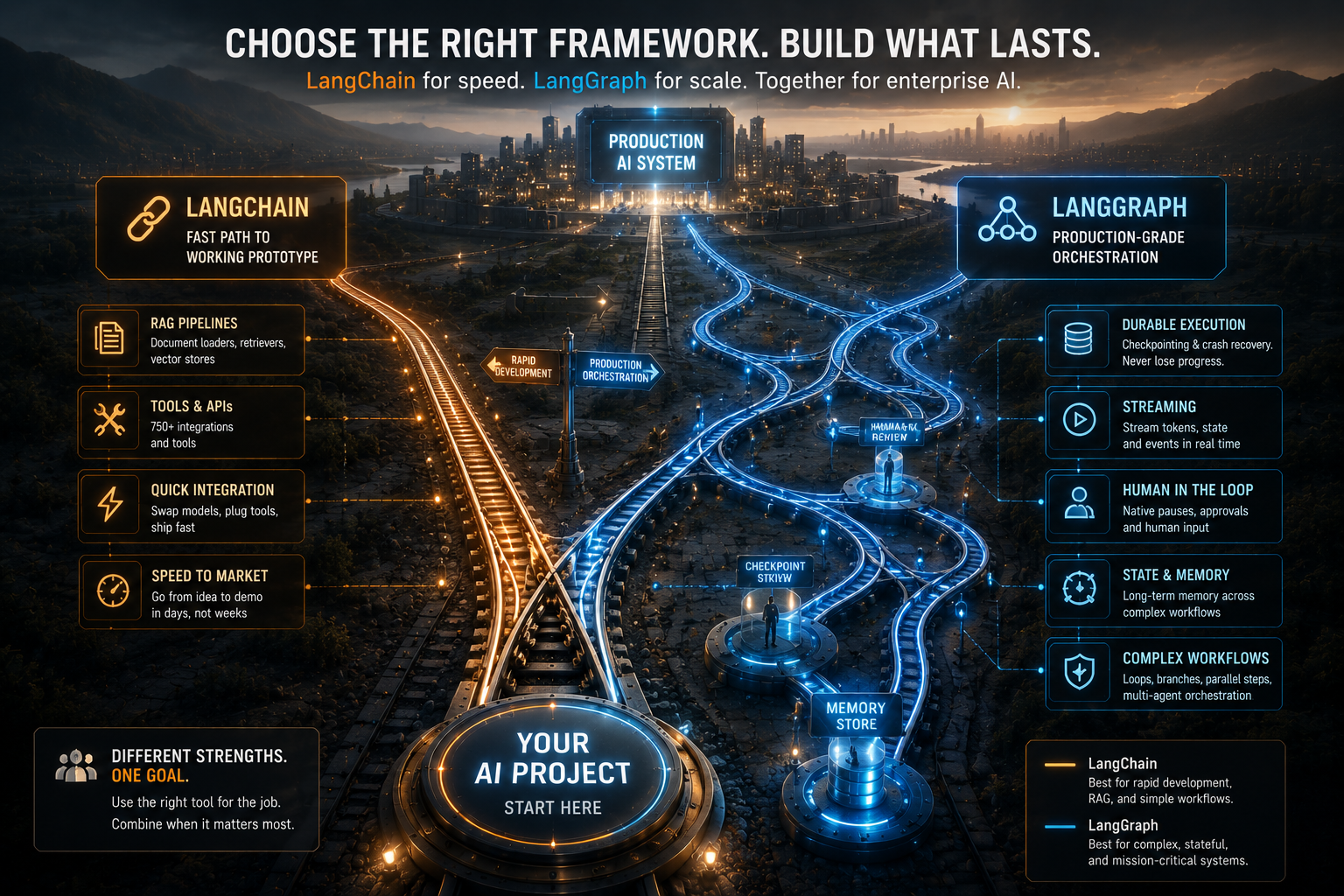
The question engineering teams ask most often when starting an AI agent project is not which model to use. It is which framework to build on. Get that wrong and months of development work lands on an architecture that cannot support what the product actually needs to do in production.
LangChain and LangGraph are the two most widely deployed open-source frameworks in the LLM application space, and they come from the same ecosystem. Both reached stable 1.0 releases in October 2025. Both are battle-tested at companies including Uber, LinkedIn, Klarna, and JP Morgan. But they solve fundamentally different problems, and the teams that run into the most expensive architecture mistakes are the ones who treat them as alternatives when they are designed to be complements.
This guide covers what each framework actually does, where each one is the right choice, where using both together is the correct answer, how they compare against the other major frameworks in the 2026 landscape, and the specific decision questions that lead to the right architecture for your project.
If your organization is building AI-powered systems and needs engineering support on framework selection, architecture design, or delivery, Marka's team works with enterprises across healthcare, manufacturing, finance, and public administration on exactly this kind of work. You can reach the team at marka-development.com/contacts.
What LangChain Actually Is in 2026
LangChain is an open-source framework for building LLM-powered applications using standardized, composable components. Its core value is breadth and speed: over 750 integrations with model providers, vector databases, tools, and APIs, combined with well-documented patterns for the most common AI application types.
LangChain 1.0, released in October 2025 alongside LangGraph 1.0, represents a fundamental shift toward stability and simplicity. The most significant architectural change is the introduction of the create_agent abstraction as the canonical way to build agents within the LangChain package, built on top of the LangGraph runtime underneath. This means LangChain agents in 2026 are not competing with LangGraph. They are running on it.
RAG pipelines and document applications. LangChain's retrieval architecture, covering document loaders, text splitters, vector store integrations, and retrieval chains, remains the fastest path to production for applications where an AI needs to answer questions grounded in private data. Independent benchmarks show LangChain completing document Q&A tasks in 1.2 seconds compared to 1.8 seconds for CrewAI equivalents, reflecting optimizations that come from years of RAG-specific development.
Model and tool flexibility. The standardized model abstraction means you can swap between Claude, GPT, Llama, Mistral, or any other provider without rewriting application logic. For teams still iterating on which model works best for their use case, this is a concrete time-saver, not just a theoretical benefit.
Speed to working prototype. LangChain consistently produces working demos faster than any other framework in this class. A developer familiar with the ecosystem can go from idea to working demonstration in a day. That speed advantage matters most in the early stages of a project when the goal is validating that the AI approach actually works before committing to an architecture.
Ecosystem depth. With 97,000 or more GitHub stars and the largest community of any LLM framework, LangChain has the most tutorials, the most third-party tooling, and the most documented solutions to common problems. When you hit an edge case, someone has probably encountered it and written about it.
Where LangChain has limits is on the production resilience side. LangChain has no native checkpointing for crash recovery. Durable execution, the ability to resume a workflow from exactly where it left off after a server restart, requires either upgrading to LangGraph or adding a separate solution like Temporal. Governance and compliance evidence requirements are typically handled at the application layer rather than natively, which creates inconsistency across teams in larger organizations.
What LangGraph Actually Is in 2026
LangGraph is a low-level agent orchestration framework built around a graph abstraction: nodes (functions or agents), edges (control flow between them), and shared state (what gets passed between nodes and persisted across the workflow). It is not a high-level framework that makes decisions for you. It is a runtime that gives you the primitives to build exactly what you need, with production behavior built in.
LangGraph 1.0 reached general availability on October 17, 2025, stabilizing four core runtime features that separate production agents from demos.
Durable execution. An agent three steps into a ten-step workflow when the server restarts picks up exactly where it left off. Checkpointing saves state at every node execution with no lost work. This is not a configuration option. It is the default behavior, and it is the single feature that most clearly marks the boundary between a framework suitable for prototypes and one suitable for production systems.
Streaming. LangGraph streams everything: LLM tokens, tool calls, state updates, node transitions. An agent that takes 30 seconds to respond feels broken unless users can see it working. Streaming output is the feature that determines whether a long-running agent is usable in a user-facing context or only viable for background processing.
Human-in-the-loop as a native primitive. LangGraph's runtime pauses execution, saves state, and waits for human input without blocking threads. When the human responds, whether seconds or hours later, execution resumes from the exact point it paused. For high-stakes domains including healthcare, finance, legal, and compliance workflows, this is not a nice-to-have. It is an architectural requirement that LangGraph is the only framework to handle natively at the runtime level.
Memory. Short-term memory through working context is built into state management. Long-term memory across sessions uses persistent checkpointers that plug into databases including SQLite and Postgres. Both are available natively without external integrations.
Since the 1.0 release, LangGraph has continued adding production-grade capabilities. Dynamic tool calling, released in early 2026, allows control over which tools are available at different points in a workflow, preventing agents from reaching for tools that are inappropriate to the current execution context. Node-level caching eliminates redundant computation and accelerates development cycles. Deferred node execution allows sophisticated flows where a node only runs after all parallel branches have completed.
LangGraph Platform, the managed deployment layer, has matured significantly alongside the core framework. LangGraph Studio provides visual debugging and time-travel, the ability to replay or fork execution from any prior checkpoint. That capability transforms debugging complex agent workflows from a painful reverse-engineering exercise into a systematic inspection process. LangGraph Cloud handles deployment and scaling for teams that want managed infrastructure rather than self-hosted agent runtimes.
The most important relationship to understand between the two frameworks is this: since LangChain 1.0, all LangChain agents are built on the LangGraph runtime. LangChain provides the components and prototyping speed. LangGraph provides the runtime those components execute on in production. They are not alternatives. They are layers.
When to Use LangChain
Use LangChain when your primary goal is feature delivery speed and your workflow is linear or moderately branching.
RAG applications and chat with your data. An internal knowledge assistant over documents, policies, and CRM notes. A customer-facing support bot grounded in your help center. LangChain's retrieval ecosystem is the fastest path to a working implementation and the most mature in the market.
Content and document automation. Summarization, extraction, classification, translation, email drafting, proposal generation. LangChain's model abstractions and structured output handling make these workflows quick to assemble and easy to iterate on.
Copilot features inside existing products. AI assistance embedded in SaaS flows, search, contextual explanations, next-step recommendations. LangChain's interoperability across LLM vendors means you are not locked into a provider decision made in week one.
Simple tool-using agents. Agents that automate straightforward repetitive tasks where the workflow is predictable: check order status, create a ticket, look up a record. LangChain's prebuilt agent patterns and extensive tool library cover the most common cases without requiring graph-level orchestration design.
The practical test is simple. If the workflow follows a predictable sequence from input to output, with limited branching and no requirement for crash recovery or multi-day execution, LangChain is the right choice. If the workflow needs to loop, branch conditionally based on AI reasoning, pause for human approval, or survive a server restart mid-execution, those are LangGraph requirements.
When to Use LangGraph
Use LangGraph when your AI application is a process, not a single interaction. Multiple steps, decisions at runtime, exceptions, handoffs, and state that needs to survive failures are the defining characteristics of the use cases LangGraph was built for.
Customer support resolution engines. Not a chatbot that deflects queries, but a system that resolves issues end-to-end across systems that were never designed to communicate with one another. An agent that verifies the original transaction, checks return-policy eligibility, processes the refund in the payment system, and updates order-management and accounting systems. Graph workflows map cleanly to real support logic: classify, route, act, handle exceptions, escalate to human when needed. LangGraph handles every step natively, with full state persistence between each.
Multi-agent systems. Applications where multiple specialized agents collaborate: one researching information, another drafting a response, a third reviewing for quality, a fourth routing for compliance approval. LangGraph's graph model gives each agent its own role within a coordinated workflow, with shared typed state ensuring each agent has the context it needs without passing fragile strings between components.
Human-in-the-loop approval workflows. In healthcare, finance, legal, and any regulated industry, agents cannot act without human oversight on specific decision types. LangGraph pauses execution at defined interrupt points, presents state to a human reviewer, and resumes from the exact point it paused after approval. This is the pattern that Komodo Health and similar healthcare AI companies use in production, where human oversight of AI decision-making is a regulatory requirement rather than a design preference.
Long-running background processes. Multi-day approval workflows, background jobs that run across multiple sessions, research processes that accumulate findings over hours. LangGraph's built-in persistence layer saves and resumes workflows at any point without requiring custom database logic. This is the class of use case that no other production-grade framework handles as cleanly.
Any production agent where downtime has real costs. If your AI application is customer-facing, mission-critical, or part of a regulated workflow, LangGraph's durable execution, built-in error handling, and time-travel debugging are the production requirements that make the difference between a system that is reliable and one that is merely functional.
When to Use Both Together
The most competitive AI applications in production in 2026 use both frameworks, and the combination is not an accident. It is the architecture the frameworks were designed to support.
The pattern is straightforward: LangChain provides the components, LangGraph provides the orchestration runtime that coordinates them. A practical example from financial services illustrates how this works in production. An investment research platform needs to pull financial data from multiple sources, analyze it using different AI models, synthesize findings into a research brief, route it for compliance review, handle feedback loops if the compliance team requests changes, and publish the approved output. The data retrieval and model calls are LangChain components. The state management, conditional routing to compliance, human-in-the-loop pause for review, feedback loop handling, and final publication are LangGraph graph nodes. Neither framework alone handles the full workflow cleanly. Together, they cover it completely.
LinkedIn's AI-powered recruiter is one of the most cited production examples of this combination. LangChain components handle natural language processing and data retrieval. A LangGraph hierarchical agent system coordinates candidate sourcing, matching, and messaging. The result freed human recruiters to focus on strategic work rather than repetitive screening, which is exactly the outcome the operational transformation model described in enterprise AI transformation frameworks predicts when agents take over process execution.
The practical advantages of the combination are three. LangChain handles rapid validation of individual AI capabilities. LangGraph orchestrates those capabilities into a durable production workflow without requiring a rewrite of the components that were already working. And because LangChain agents are built on the LangGraph runtime since the 1.0 releases, there is no architectural friction between the layers.
How They Compare to the 2026 Framework Landscape
LangChain and LangGraph do not exist in isolation. The 2026 agent framework landscape has consolidated significantly, and understanding how the main alternatives compare is essential context for making the right decision.
CrewAI. The most intuitive framework for role-based multi-agent systems. Developers consistently report getting a working multi-agent prototype running faster with CrewAI than with any other option, with approximately 30 to 60 lines of code versus 80 to 150 for equivalent LangGraph implementations. CrewAI is built on top of LangChain, which means it inherits the LangChain integration ecosystem. The trade-offs appear at production scale: CrewAI carries up to three times the token footprint of LangGraph on simple single-tool-call workflows in independent benchmarks, and its role-based abstraction becomes a liability when workflows need fine-grained conditional branching or precise state management. The migration path from CrewAI to LangGraph is well-documented and widely used by teams that outgrow the role-based mental model. The honest recommendation from multiple practitioners in 2026 is the same: start with CrewAI to validate the concept, migrate the parts that need production hardening to LangGraph.
Microsoft Agent Framework. The consolidated successor to AutoGen and Semantic Kernel, reaching 1.0 general availability in April 2026. For organizations already operating on Microsoft infrastructure including Azure, Active Directory, and Microsoft 365, the Microsoft Agent Framework removes months of integration work that other frameworks require. It exposes responsible AI guardrails through Azure AI Foundry and supports both Python and .NET runtimes. As a Microsoft Gold Certified Partner, Marka's team works with this framework alongside LangChain and LangGraph for enterprise clients where the Microsoft stack is already the platform of record, because the governance and observability tooling available through Azure AI Foundry addresses requirements that otherwise require separate integration work.
PydanticAI. A newer framework with a tighter type-safety model. Teams that want agents built with validated inputs and outputs and dependency injection, the way they build the rest of their Python backend, increasingly choose PydanticAI for its integration with the Pydantic ecosystem. The trade-off is ecosystem breadth: fewer pre-built templates and community connectors than LangChain.
LlamaIndex. Best-in-class for RAG-heavy and knowledge-driven agents. The data-connector ecosystem and advanced indexing strategies give it a defensible lead for any agent that needs grounding in private enterprise knowledge. The trade-off is specialization: complex multi-agent orchestration outside retrieval workflows feels less natural than LangGraph or CrewAI.
The clearest summary of the landscape as of mid-2026 is this: use LangChain for the broadest integration breadth and fastest prototyping, LangGraph for production-grade stateful workflows and multi-agent orchestration, CrewAI for the fastest path to a working role-based prototype, Microsoft Agent Framework for organizations deeply embedded in Azure and the Microsoft stack, and LlamaIndex for RAG-first and document-heavy applications. These are not mutually exclusive choices, and the most sophisticated production systems frequently combine more than one.
The Decision Framework: Four Questions That Determine the Right Architecture
How complex is the workflow? If the application follows a predictable linear sequence: retrieve, process, respond, LangChain's create_agent is the fastest and most cost-efficient path. If the workflow involves conditional branching based on AI reasoning, loops, retries, parallel execution with merging, or multiple agents coordinating, those are LangGraph requirements. The graph mental model was designed specifically for workflows that cannot be expressed as a straight assembly line.
What are your production resilience requirements? For internal tools, prototypes, and low-stakes applications where a restart and retry is an acceptable response to a failure, LangChain's simplicity is an advantage. For customer-facing applications, regulated industry workflows, or any system where mid-workflow failures carry real business costs, LangGraph's durable execution and time-travel debugging are the production requirements that determine whether the system is reliable or merely functional.
Do you need human approval at specific decision points? If yes, LangGraph is the correct answer. Human-in-the-loop as a native runtime primitive is LangGraph's most distinctive capability and the one that no other framework handles as cleanly at scale. Building this at the application layer, which is the alternative in LangChain or CrewAI, creates fragile implementations that are difficult to debug and impossible to audit reliably, which matters significantly in regulated industries.
Where is your organization's technology stack? For teams on the Microsoft stack with Azure as the deployment platform, the Microsoft Agent Framework and its Azure AI Foundry integration address governance, observability, and responsible AI requirements that otherwise require separate tooling. For teams not embedded in the Microsoft ecosystem, LangChain and LangGraph with LangSmith for observability provide equivalent production capability with a larger community and a broader integration ecosystem.
Performance and Cost Reality
An independent benchmark running 2,000 task instances across five tasks and four frameworks in 2026, on the same underlying model, produced findings that differ meaningfully from what framework documentation suggests.
LangGraph was fastest on latency across all five tasks. LangChain was most token-efficient overall. AutoGen matched LangGraph on latency with a different token profile. CrewAI carried the heaviest overall token footprint on simple tasks, roughly three times the tokens of the other three for single-tool-call workflows.
A separate academic evaluation published in November 2025 documents a 37 percent average gap between lab benchmark scores and production deployment performance across frameworks. The consistent finding is that the performance difference between frameworks matters less than the production reliability and observability characteristics. The teams that get into the most expensive situations are the ones that chose a framework based on benchmark performance and discovered in production that debugging, crash recovery, and human oversight were the actual bottlenecks.
LangSmith, the observability platform from LangChain that works with any LLM framework regardless of whether it uses LangChain or LangGraph, addresses the observability requirement for teams in the ecosystem. LangSmith for production observability runs approximately $400 to $800 per month for teams and should be factored into the total cost model early. For teams outside the LangChain ecosystem, Langfuse and Arize are the most widely used alternatives.
Common Architecture Mistakes and How to Avoid Them
Choosing LangChain for a workflow that needs durable execution. The symptom is agents that fail mid-workflow without recovery and require manual restart and state reconstruction. The fix is LangGraph for the orchestration layer, with LangChain components providing the tools and model integrations the graph nodes need.
Choosing LangGraph for a simple linear workflow. LangGraph's learning curve is steep. Its documentation is fragmented across three sites: LangGraph, LangChain, and LangSmith. Stack traces run deep. For a workflow that is genuinely linear, the complexity cost of LangGraph is not justified by the production features it provides. Use create_agent from LangChain for simple cases and migrate to LangGraph when workflow requirements demand it.
Building human-in-the-loop at the application layer instead of the runtime layer. This is the most common mistake in regulated industry AI deployments. Application-layer human approval implementations are difficult to pause correctly, difficult to resume reliably, and difficult to audit because approval state is managed in application code rather than in a persistent runtime. The result is approval workflows that work in happy-path scenarios and fail in the edge cases that matter most for compliance.
Not instrumenting observability from the start. The most expensive debugging sessions in agent development happen when something breaks in production and the team has no trace data to work from. Connecting LangSmith or an equivalent observability layer from day one is the difference between debugging in minutes and debugging in days.
What to Do Next
Three questions are worth working through before committing to a framework for your next AI project.
Does your workflow need to survive a server restart mid-execution? If yes, you need LangGraph. If no, LangChain's create_agent is the right starting point and you can adopt LangGraph components progressively as the workflow complexity grows.
Will an AI agent need to pause and wait for human approval before taking a specific action? If yes, design for LangGraph's interrupt primitive from the start, not as an afterthought. Retrofitting human-in-the-loop into an application-layer implementation after the fact is significantly more expensive than architecting for it correctly in the first sprint.
Are you on the Microsoft stack? If your organization runs on Azure and Microsoft 365, evaluate the Microsoft Agent Framework alongside LangGraph before committing to an architecture. The governance and responsible AI tooling available through Azure AI Foundry may address requirements that would otherwise require separate integration work.
Marka's Cloud and Platform Modernization practice includes AI application architecture as a core component of enterprise modernization engagements. The organizations that treat framework selection as an architectural decision rather than a procurement decision are consistently the ones that reach production scale without the expensive mid-project rewrites that follow the wrong early choice. If your team is making this decision now, the conversation is worth having before the first sprint rather than after it. You can reach Marka's team at marka-development.com/contacts.