SDLC Audit Checklist: How to Audit Your Software Development Process Today
An SDLC audit does not tell you if your software is secure today. It tells you if your process can produce secure software consistently. A practical guide to auditing every phase of your development lifecycle.
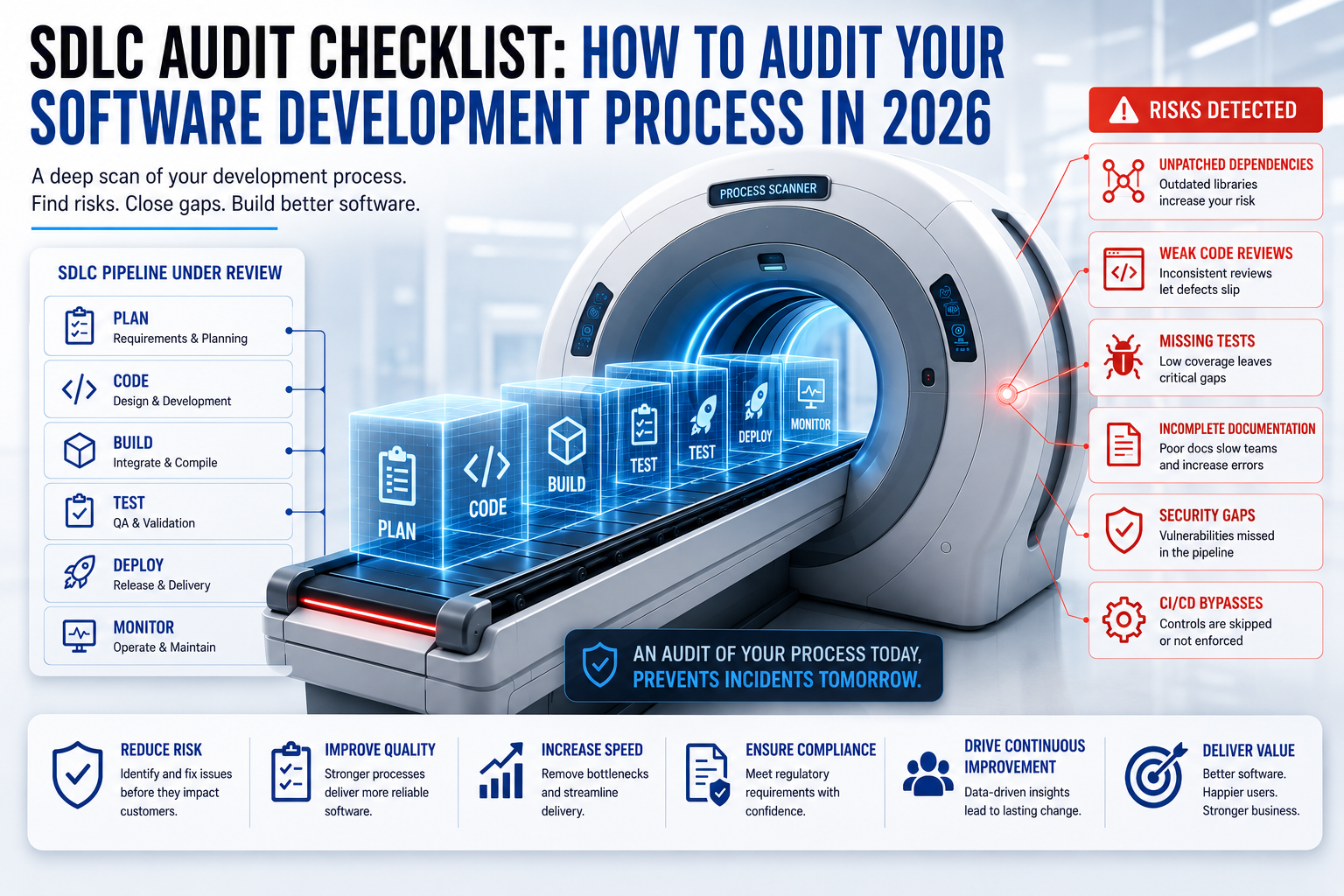
Most delivery problems that reach executive level, a project running months over budget, a security breach, a failed compliance review, were visible long before they escalated. The process that should have surfaced them was either absent, incomplete, or never audited. That is the pattern that repeats across industries and organization sizes, and it is why a software development lifecycle audit is one of the highest-return reviews an enterprise team can run.
According to Verizon's 2025 Data Breach Investigations Report, exploitation of software vulnerabilities as an initial breach vector rose 34% year over year and now accounts for one in five data breaches. The vulnerabilities being exploited were not zero-day discoveries. Most were known, documented weaknesses that organizations had months to address. The process to find and fix them was never audited.
An SDLC audit does not tell you whether a specific piece of software is secure today. It tells you whether your development process is capable of producing secure, maintainable software consistently, across teams, projects, and time. That distinction is what makes it a governance tool, not just a technical review.
Marka's engineering team has been working with enterprises across healthcare, manufacturing, finance, and public administration since 1993. If your organization is carrying delivery risk, compliance pressure, or technical debt that has become a business problem, the right starting point is a conversation. You can reach the team at marka-development.com/contacts.
What an SDLC Audit Actually Reviews
An SDLC audit is a structured assessment of your software development process across every phase, from requirements and architecture through development, testing, deployment, and maintenance. It is distinct from a code review, which evaluates a specific codebase, and from a security penetration test, which probes for exploitable vulnerabilities at a point in time.
What the audit evaluates is process maturity: whether the right gates exist, whether they are consistently applied, whether the evidence of their application is documented, and whether the organization has the visibility to catch problems before they become incidents. The output is not a list of bugs. It is a set of process findings with severity ratings, root cause analysis, and specific remediation recommendations that a technical team can act on and that a compliance function can verify.
The six domains below represent the areas where audit findings most commonly surface in enterprise development environments.
Coding Standards and Practices
Inconsistent coding practices accumulate technical debt silently. Code that was written without agreed standards becomes progressively harder to maintain, extend, and hand over, and the cost of that difficulty compounds over time in ways that do not appear in any single sprint's metrics.
A coding standards audit reviews whether internal guidelines exist and are consistently followed, whether automated enforcement is in place through linters and static analysis tools, and whether code reviews are structured enough to catch deviations before they reach the main branch. It also reviews version control practices: commit frequency and quality, branch management, and whether the history of changes is legible enough to support incident investigation when something goes wrong.
Dependency management is a consistently underauditied area in enterprise environments. Organizations that manage dozens of dependencies across multiple projects often have no systematic process for tracking when those dependencies receive security updates or when vendor support ends. The audit reviews whether tools like npm, pip, or NuGet are used consistently, whether dependency update cycles are defined, and whether there is a documented process for evaluating security advisories against the current dependency set.
AI-generated code introduces a process risk that most existing SDLC frameworks have not yet addressed. As of 2025, over half of professional developers use AI development tools daily. That adoption has accelerated delivery timelines and introduced a class of review gap that standard code review processes were not designed to catch. A mature audit in 2026 includes an explicit assessment of how AI tools are integrated into the development workflow, what governance exists around the use of their output, and whether the review gates designed to catch human errors are also equipped to catch AI-generated ones.
Quality Assurance Practices
Discovering defects in post-production is consistently more expensive than discovering them during development. The cost differential varies by study and methodology, but the direction is consistent across every measurement: quality problems that survive to production cost more than quality problems caught earlier. An underdeveloped QA process does not just produce buggy releases. It produces a delivery pipeline where the real state of the software is unknown until customers report problems.
The QA audit reviews testing strategy coverage across unit, integration, system, and acceptance levels. It evaluates whether test cases include negative scenarios and edge conditions, not just happy-path coverage. Regression testing automation is a specific focus: manual regression testing against a growing codebase does not scale, and organizations that have not invested in test automation typically see regression coverage erode as the system grows.
CI/CD integration is where QA process maturity most directly shows up in delivery outcomes. An audit of the CI/CD pipeline reviews whether automated testing is integrated at the right points in the pipeline, whether test failures actually block deployments or are routinely overridden, and whether the pipeline configuration itself is version-controlled and audited. A CI/CD setup that can be manually bypassed under delivery pressure is not a quality gate. It is a suggestion.
Defect tracking process is reviewed for completeness and timeliness. The audit looks at how defects are documented, prioritized, and resolved, and specifically whether there is a pattern of deferred defects that have been open for extended periods without resolution or formal acceptance. A growing backlog of deferred defects is one of the clearest leading indicators of future delivery problems.
Security Measures
Security gaps in the development process have a compounding characteristic that makes them particularly expensive to address reactively. A vulnerability introduced in architecture is cheaper to fix at design review than at code review, cheaper at code review than at QA, and vastly cheaper at QA than in production. An SDLC security audit is not a penetration test. It reviews whether the process has the right controls at the right points to prevent vulnerabilities from reaching production in the first place.
Access control to code repositories is a frequent finding in enterprise environments. The audit reviews who has access to production codebases, whether offboarding processes are enforced consistently, and whether access is reviewed periodically rather than only when someone leaves. Unauthorized code repository access is a supply chain security risk under NIS2, DORA, and ISO 27001, and the audit evidence required to demonstrate compliance starts here.
Third-party library security is reviewed for process maturity rather than for a current vulnerability scan. The audit asks whether there is a defined process for monitoring dependencies for known vulnerabilities, whether that process runs on a schedule or only on request, and whether security advisories from major dependency registries are tracked systematically.
Incident response readiness is evaluated as a process capability, not just as a document. The audit reviews whether incident response plans exist, whether they have been tested, and whether the development team has clear roles and escalation paths when a security event occurs. Organizations that discover during a real incident that their response plan has never been exercised are in a substantially worse position than those that have run structured tabletop exercises against it.
Secure configuration management covers server and application configurations against security baselines. Misconfigured cloud infrastructure and application settings are among the most common initial access vectors in enterprise breaches, and they are entirely preventable through process controls.
Documentation
Poor documentation has a deferred cost that organizations underestimate because it does not appear as a line item until it becomes a problem. New developer onboarding takes longer. Incident investigation is slower because system behavior is not documented. Compliance reviews require evidence that does not exist. Architecture decisions made three years ago cannot be evaluated because the rationale was never recorded.
The documentation audit reviews requirements documentation for completeness, accuracy, and traceability to test cases and acceptance criteria. It reviews architecture documentation for currency, since architecture diagrams that reflect how the system was designed rather than how it currently operates create misleading assumptions during incident response and during modernization planning. It reviews API documentation for usability by both internal teams and any third-party integrations that depend on the interfaces.
Deployment and configuration guides are a specific focus for regulated environments. The audit reviews whether deployment procedures are documented in sufficient detail that a trained engineer who was not involved in the original build can execute a deployment or a rollback without undocumented tribal knowledge.
Project and Resource Management
Delivery failures that appear to be technical problems are frequently process problems. Requirements that were never fully specified, scope that was agreed verbally and never documented, estimates that were made without a structured methodology, handoffs between teams that relied on shared understanding rather than documented artifacts. These patterns repeat across industries and organization sizes, and an SDLC audit surfaces them before they become project failures.
The project management audit reviews whether the chosen methodology, whether Agile, Waterfall, or a hybrid, is applied consistently or selectively when convenient. It reviews whether requirements are documented with sufficient specificity for development teams to build against and for QA teams to test against. Change management process is a specific focus: the audit evaluates whether scope changes are formally assessed for impact on timeline, resource, and quality before they are accepted, or whether the team absorbs changes informally until the accumulation produces a delivery failure.
Knowledge concentration risk is a finding that appears regularly in enterprise development audits and is rarely tracked formally. When critical system knowledge is concentrated in one or two individuals, the organization carries a delivery risk that is not visible in any standard project metric until one of those individuals is unavailable. The audit identifies areas of high knowledge concentration and evaluates whether documentation and cross-training practices are sufficient to mitigate that risk.
Deployment and Release Process
The deployment pipeline is where process quality across every other domain either holds or collapses under delivery pressure. An organization with strong coding standards, robust QA, and mature security practices can still produce unreliable releases if its deployment process is manual, undocumented, or inconsistently executed.
The deployment audit reviews whether release procedures are automated and version-controlled, whether there is a defined and tested rollback procedure for every release type, and whether deployment to production requires a documented approval and sign-off process. It also reviews environment consistency: differences between test and production environments are a persistent source of release failures that appear in QA as intermittent or unreproducible and manifest in production as systematic.
Post-deployment validation is a process step that many organizations skip under release pressure. The audit reviews whether there is a defined set of validation checks that run after every production deployment, whether those checks are automated or manual, and whether there is a clear decision point at which a failed post-deployment validation triggers a rollback rather than a watch-and-wait response.
Who Needs an SDLC Audit
Several situations consistently indicate that an SDLC audit would deliver material value to the organization.
Projects running consistently late or over budget without a clear technical explanation are typically a process problem rather than a capacity problem. An audit surfaces the specific process gaps that produce schedule slippage before the pattern repeats on the next project.
Organizations preparing for compliance certification, whether NIS2, DORA, ISO 27001, SOC 2, or HIPAA, need to demonstrate process maturity to auditors with evidence documentation. An SDLC audit run before the compliance review identifies the gaps that would produce findings during certification and gives the team time to address them.
Organizations considering a modernization program benefit from an SDLC audit before scoping the work. Modernization projects that inherit process problems from the legacy development environment reproduce those problems in the new architecture. Understanding the process state before the migration begins is the work that determines whether the modernization improves delivery quality or just moves the debt to a newer stack. Marka's Enterprise Platforms and Modernization practice treats the SDLC audit as a standard input to every modernization engagement for this reason.
Organizations that have experienced a security incident or a significant production failure need a process audit to understand whether the event was a one-time failure or a symptom of a systematic process gap. The post-incident root cause analysis that stops at the technical finding, "a dependency had a known vulnerability," without reaching the process finding, "our dependency management process had no systematic advisory monitoring," produces remediation that addresses the symptom rather than the cause.
What to Do Next
An SDLC audit is most valuable when it is run before a problem reaches the executive level rather than in response to one. The findings are the same either way. The cost of acting on them is not.
Three actions are worth taking before your next compliance review, modernization planning cycle, or board-level risk discussion.
Assess your current process documentation coverage. If a core member of your development team left tomorrow, how much of the process would leave with them? The answer to that question is a reasonable proxy for the documentation and knowledge concentration risk that an audit would surface.
Review your dependency and patch management posture. How many of the libraries your production systems depend on have received security updates in the last 90 days that your team has not yet evaluated? If you do not know the answer, the process to find out does not exist or is not running.
Map your compliance evidence gaps. If your organization is in scope for NIS2, DORA, or ISO 27001, which of the required process controls can you demonstrate with evidence today, not policy documents, but actual logs, configurations, test results, and audit trails? The gaps in that mapping are the SDLC audit scope.
Marka's team works with enterprises at each of these stages, from initial process assessment through remediation delivery and compliance preparation. You can review the QA and DevOps Automation work the team delivers, explore the industries we serve, or get in touch directly at marka-development.com/contacts.