What Is the Discovery Phase in a Software Project and What Does It Produce
The discovery phase turns a business idea into a costed, risk-assessed plan before development begins. Here is what it produces, what it costs, and when skipping it creates the most expensive problems.
Only 31 percent of software projects finish on time, on budget, and within scope. That figure has held roughly steady for three decades of tracking by the Standish Group, through waterfall, agile, and hybrid delivery models. It has not improved as teams got better tools, better methodologies, or more experienced engineers. It has stayed flat because the most common cause of project failure is not engineering execution. It is inadequate scoping before the first sprint begins.
The discovery phase is the structured work that closes that gap. It is the period between a business idea and a development contract where a cross-functional team of business analysts, architects, UX designers, and project managers transforms an abstract requirement into a concrete, costed, risk-assessed plan that a development team can execute against with confidence.
Organizations that invest 5 to 10 percent of their total project budget in a structured discovery phase spend 40 to 60 percent less on development than those that skip it, according to research across the 2025 and 2026 project management literature. The arithmetic is straightforward: fixing a requirements error during discovery costs a fraction of what it costs to fix in development, and a fraction of a fraction of what it costs post-launch. The discovery phase is not overhead on the development project. It is the investment that determines whether the development project delivers what it was supposed to.
This article covers what the discovery phase is, what it produces, how long it takes, what it costs, and the specific situations where skipping it reliably produces the worst outcomes.
Marka has been running discovery engagements for enterprises across healthcare, manufacturing, finance, and public administration since 1993. If your organization is planning a software project and has not yet run a structured discovery, the right starting point is a conversation before a contract. Reach the team at marka-development.com/contacts.
What the Discovery Phase Actually Is
The discovery phase is the first formal stage of a software project. It occurs after a business need has been identified and before development begins. Its purpose is to transform a business idea into a technically validated, stakeholder-aligned plan with concrete scope, architecture direction, cost estimation, and risk documentation.
What it is not is a sales exercise, a high-level requirements gathering session, or a series of workshops that produce slide decks. A well-run discovery phase produces specific, usable artifacts that the development team can work from directly: user stories with acceptance criteria, an architecture decision document, a clickable prototype, a risk register with mitigation plans, and a development roadmap with a cost estimate narrow enough to present to a board or an investor.
The distinction matters because many projects that claim to have completed a discovery phase have completed something different, a few stakeholder interviews, a features list, and a rough timeline. These produce false confidence rather than genuine risk reduction. The Standish Group's research is consistent on this point: projects that invest in structured, deliverables-focused discovery consistently outperform those that treat discovery as an administrative step on the way to development.
The discovery phase involves a specific team composition. A business analyst owns requirements elicitation, user story development, and acceptance criteria. A UX designer owns user research, journey mapping, wireframes, and the interactive prototype. A solution architect owns the technical approach, integration mapping, data model decisions, and architecture documentation. A project manager owns timeline, RACI, risk register, and the discovery-to-development handoff. Skipping any of these roles skips the work that role produces, and the absence of that work shows up later in the development project as ambiguity, rework, or failure.
Why Software Projects Fail Without It
<cite index="27-1">Nearly one in three enterprise projects still fail to deliver measurable ROI, according to Tempo Software's 2026 State of Strategic Portfolio Management Report, even at organizations using modern portfolio management practices.</cite> The root cause, across the research consistently, is requirements problems, not engineering problems.
<cite index="20-1">Uncontrolled expansion of requirements, scope creep, affects 48 percent of all IT initiatives, leading to delayed releases and significant cost overruns.</cite> Scope creep is not a project management failure. It is a discovery failure. Requirements that were never fully specified during discovery get specified during development, where specifying them competes with building them, and where changing them after architecture decisions have been made costs multiples of what they would have cost to get right upfront.
<cite index="24-1">One in five enterprise projects still fails to meet its business goals, and the root cause is almost always inadequate upfront scoping, not engineering execution, according to CIO.com's 2025 analysis.</cite> The pattern is consistent enough that experienced development organizations can predict which projects will fail before development begins, by examining how much structured work was done in discovery.
The cost-of-change curve is the mechanical explanation for why this happens. A requirements error caught during discovery costs roughly one unit of effort to correct: the requirement is updated, the affected user stories are revised, the estimate is adjusted. The same error caught during development costs ten to twenty units: code has been written against the wrong requirement, tests have been written to validate the wrong behavior, and the architectural decisions made on the basis of the wrong requirement may need to change. The same error caught post-launch can cost one hundred units or more: production data may need to be migrated, live users are affected, rollback is complex, and the downstream systems that depend on the incorrect behavior need to change.
Discovery does not eliminate requirements errors. It catches them at the cheapest possible point in the project lifecycle.
What the Discovery Phase Produces
The output of a well-run discovery phase is a set of specific artifacts that eliminate ambiguity for every subsequent stage of the project. The specific deliverables vary by project type, complexity, and organization, but the following represent the standard set for enterprise software projects.
Software Requirements Specification. The SRS is the primary requirements document. It defines the system's functional requirements, what the software must do, and its non-functional requirements, how it must perform, including response time, availability, security, scalability, and compliance constraints. A well-written SRS is specific enough that a developer who was not in any discovery workshop can understand what they are building and why, and a QA engineer can derive test cases from it directly. Vague requirements that mean different things to different stakeholders are the signal that the SRS has not been done properly. Requirements like "the system should be fast" are not requirements. Requirements like "page load time under 200 milliseconds at 10,000 concurrent users" are.
User personas and journey maps. Personas define the specific user types the software serves, with their goals, contexts, pain points, and technical proficiency levels. Journey maps trace each persona's path through the system, from first contact to goal completion, identifying the moments where the current experience fails them and where the new system needs to intervene. These artifacts are not marketing documents. They are the design constraints that determine which features are essential and which are scope creep in disguise.
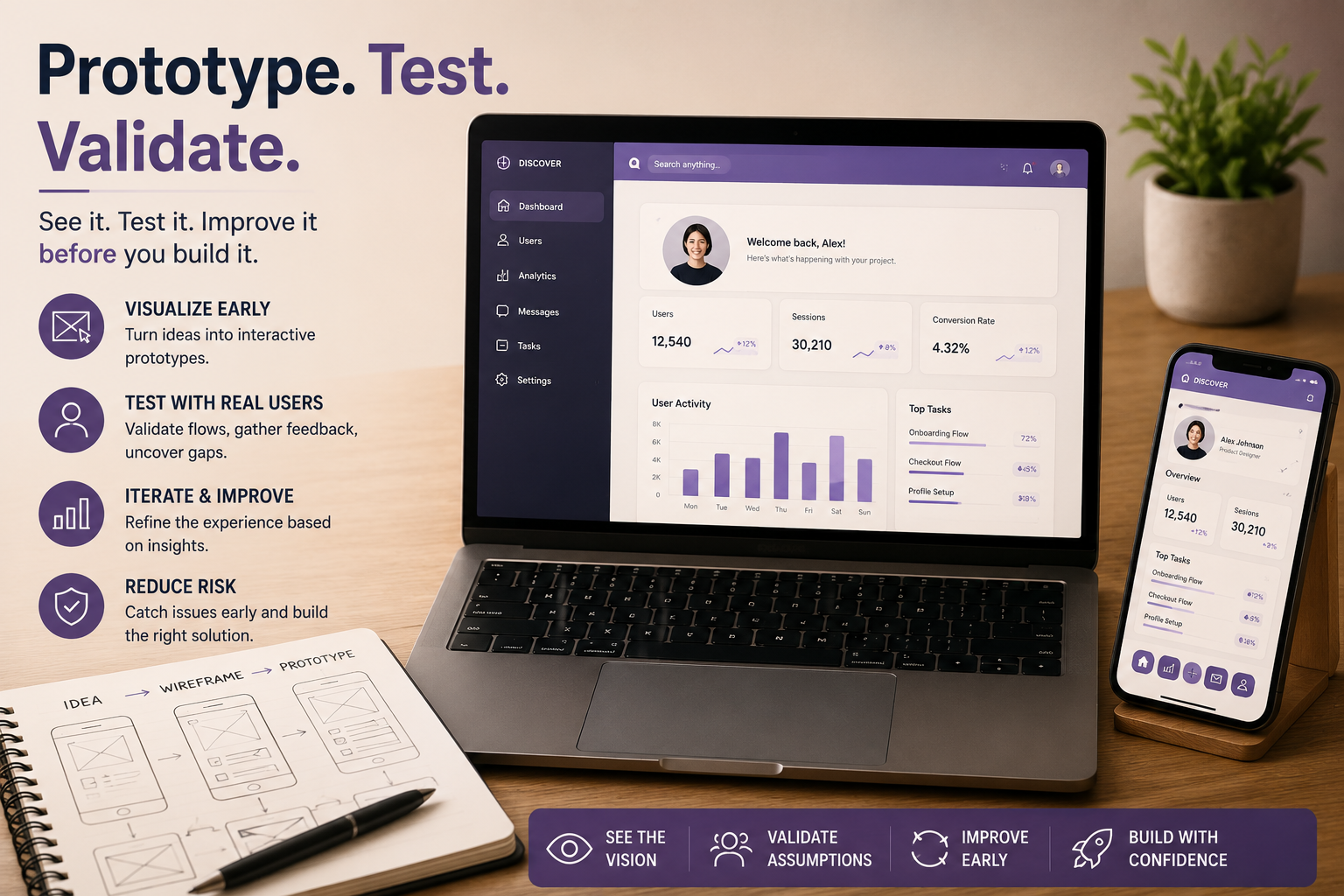
Interactive prototype. A clickable prototype built in Figma or an equivalent tool allows stakeholders to experience the proposed system before a line of code is written. The prototype surfaces usability problems, stakeholder misalignments, and missing requirements that written specifications do not reveal. It is also the artifact that most directly enables investor conversations, board presentations, and vendor evaluations, because it makes the abstract concrete without the cost and risk of actual development.
System architecture document. The architecture document captures the technical decisions made during discovery: the technology stack and the reasoning behind it, the integration approach for every external system the software connects to, the data model structure, the infrastructure approach (cloud provider, deployment model, scalability approach), and the security architecture including authentication, authorization, and data protection. These decisions are significantly cheaper to make and revise during discovery than after development has begun against an architecture that turns out to be wrong.
<cite index="24-1">A discovery engagement for a healthcare scheduling platform revealed the need for a dedicated audit trail service, automated billing via web scraping because the insurance provider had no API, and an Anti-Corruption Layer to isolate legacy systems from new code. Development spanned seven years across 2,726 Jira tickets, and the architectural foundation laid during that initial discovery held without a major redesign throughout.</cite> That kind of longevity is the direct return on an architecture document written before the first sprint.
Risk register. The risk register documents every identified project risk with its likelihood, potential impact, and planned mitigation. Technical risks, integration risks, compliance risks, dependency risks, and organizational risks all belong here. A risk register produced during discovery is actionable: it identifies which risks require mitigation before development begins, which require contingency planning, and which are acceptable. A risk register produced after development begins is a post-mortem in progress.
Development roadmap and cost estimate. The roadmap sequences the development work in phases, with each phase producing a deployable, testable increment of the system. The cost estimate specifies the development effort required for each phase with a defined confidence interval. The standard for a well-run discovery is an estimate accurate to plus or minus 25 percent, compared to the plus or minus 400 percent accuracy of estimates made without discovery. That difference is what makes board and investor presentations credible rather than speculative.
Discovery Phase Timeline and Cost
Timeline depends on project complexity and the number of stakeholders involved.
For straightforward MVPs and smaller digital products, discovery typically runs one to two weeks. The team is small, the stakeholder group is limited, and the architecture decisions are narrow in scope. The output is a defined MVP scope, basic wireframes, a simple technical approach, and an initial cost estimate.
For medium-complexity platforms with multiple user types, several external integrations, and a cross-functional stakeholder group, discovery runs two to four weeks. This is the most common scope for custom software projects at mid-market organizations.
For large-scale enterprise systems with regulatory compliance requirements, legacy system integrations, distributed stakeholder groups across business units, and architecture decisions that carry long-term consequences, discovery runs four to eight weeks. <cite index="18-1">Several factors directly influence duration at this scale: the number of decision-makers involved (three to five versus ten or more distributed participants), the depth of user interviews required (five to ten for early validation versus fifteen to twenty-five for broader research), integration requirements, legacy system dependencies, and compliance checks.</cite>
Cost for a structured discovery engagement typically falls between 5 and 10 percent of the total estimated development budget. For a project with a 100,000 euro development estimate, the discovery investment is 5,000 to 10,000 euros. <cite index="21-1">Companies that skip discovery spend 40 to 60 percent more on development than those who invest in it upfront.</cite> On the same 100,000 euro project, skipping discovery to save 5,000 to 10,000 euros exposes the organization to 40,000 to 60,000 euros in avoidable development overrun. The math consistently favors discovery.
For enterprise-scale projects, discovery costs can exceed 25,000 euros when the scope involves multiple business units, significant user research, complex integration mapping, or regulated environments requiring compliance architecture from the start. At that scale, the ROI calculation is even more compelling: the cost of a compliance architecture error discovered post-launch in a regulated industry is not measured in development rework. It is measured in regulatory penalties, remediation timelines, and in the worst cases, product withdrawal.
How Discovery Looks Different in Enterprise and Regulated Environments
The standard discovery deliverables apply to every project. What changes in enterprise and regulated environments is the depth of specific deliverables and the addition of discovery work that smaller projects do not require.
Compliance architecture from day one. For projects in healthcare, financial services, manufacturing, or public administration, compliance requirements are not a post-development concern. They are architectural constraints that determine which technology choices are available, which data handling patterns are acceptable, and which integration approaches require additional controls. Retrofitting HIPAA safeguards or NIS2 compliance controls into an existing architecture is five to ten times more expensive than designing for them from the start. Discovery for regulated environments includes a compliance requirements analysis that maps regulatory obligations to specific architectural decisions before any design work begins.
Stakeholder complexity management. Enterprise projects involve stakeholder groups whose interests do not always align: business units with different requirements, IT with infrastructure and security constraints, legal and compliance with regulatory obligations, finance with cost and timeline expectations, and end users with usability needs. Discovery for enterprise projects dedicates explicit time to stakeholder alignment work that smaller projects can complete informally. A RACI matrix that is wrong in discovery produces conflicts during development that delay delivery and increase cost.
Legacy system integration mapping. Enterprise projects almost always involve integration with existing systems: ERP, CRM, HR platforms, identity management, data warehouses, and operational systems that have been running for years and have undocumented behavior that only emerges under specific conditions. <cite index="15-1">One agriculture-sector discovery engagement revealed 295 Power BI reports across two SQL Servers when the organization had estimated approximately 100 reports and had not mentioned the second server at all. Without discovery, the migration estimate would have been off by a factor of three.</cite> Integration mapping during discovery surfaces these hidden complexities before they become mid-development surprises.
AI readiness assessment. For projects that include AI components, whether predictive models, generative features, or agentic workflows, discovery in 2026 includes an explicit assessment of data readiness. AI projects fail most often because of data problems, not model problems. Discovery validates that the data the AI component requires is available, clean, and accessible at the latency the application needs, before the AI development work begins. Discovering a data quality problem or a batch-processing architecture incompatibility during discovery is a planning adjustment. Discovering it after the model has been developed and the integration has been built is a project failure.
When to Run a Discovery Phase and When You Can Skip It
Discovery is not required for every software project. There are situations where the scope is defined well enough, the architecture is familiar enough, and the stakeholder alignment is strong enough that formal discovery adds less than its cost.
Discovery is essential when one or more of the following conditions apply.
The requirements are complex or contested. If different stakeholders have different understandings of what the software should do, and those differences have not been formally resolved, they will surface during development at maximum cost. Discovery is the mechanism for resolving them.
The project involves significant technical unknowns. New technology stack, unfamiliar integrations, AI components with data dependencies, or architecture decisions that cannot be reversed without significant cost all require the validation that discovery provides.
The project has regulatory compliance requirements. Compliance constraints that are discovered during development are expensive. Compliance constraints discovered post-launch are potentially company-ending. Discovery is the correct time to establish compliance requirements and map them to architectural decisions.
The project has significant organizational consequences. Systems that affect multiple business units, customer-facing systems at scale, or platforms that replace existing workflows that the business depends on require the stakeholder alignment and risk management that discovery provides.
Discovery can be reduced or skipped when the project is a well-defined extension of an existing system with known architecture, when the team has delivered identical scope before with the same stakeholders, or when the project is a time-boxed spike to validate a specific technical hypothesis. Even in these cases, a lightweight discovery of one to two days to align on scope and acceptance criteria is almost always worth the time.
What Marka's Discovery Engagements Produce
Marka's discovery practice, built over thirty years of enterprise software delivery across healthcare, manufacturing, finance, and public administration, produces the standard deliverables described above with the enterprise-specific additions that regulated environments require.
Every discovery engagement Marka runs produces a Software Requirements Specification, user personas and journey maps, an interactive Figma prototype, a system architecture document with technology decisions and integration mapping, a risk register with mitigation plans, a compliance requirements analysis where applicable, and a phased development roadmap with a cost estimate at plus or minus 25 percent accuracy.
For organizations on Microsoft's stack, the Cloud and Platform Modernization practice integrates discovery findings directly into Azure architecture design, ensuring that the technology decisions made during discovery are implementable within the organization's existing infrastructure and governance framework.
Discovery engagements at Marka are fixed-price with named deliverables. If the build follows, the discovery cost is accounted for against the risk reduction it produced. If the organization decides not to build, they walk away with a complete specification they can take to any vendor, and with the knowledge of what the project actually requires before committing a development budget.
What to Do Next
Three situations most commonly indicate that a discovery phase should be the immediate next step.
You have a software idea or a business requirement but no clear specification. The gap between an idea and a buildable specification is exactly what discovery closes. Starting development without closing that gap produces the scope creep, budget overrun, and delivery failure statistics cited throughout this article.
You have received development estimates from vendors that vary significantly from one another. Wide variation in estimates is the signal that different vendors are making different assumptions about scope. Discovery produces a specification that eliminates that ambiguity and makes vendor estimates comparable on an equal basis.
You are planning a project in a regulated environment and have not yet mapped compliance requirements to architectural decisions. The cost of that mapping is significantly lower before development begins than after. Discovery is the correct time to do it.
Marka's team is available to discuss your project and scope a discovery engagement appropriate to its complexity. You can review the Enterprise Platforms and Modernization work the team delivers or reach out directly.